As an Amazon Associate, I earn from qualifying purchases.
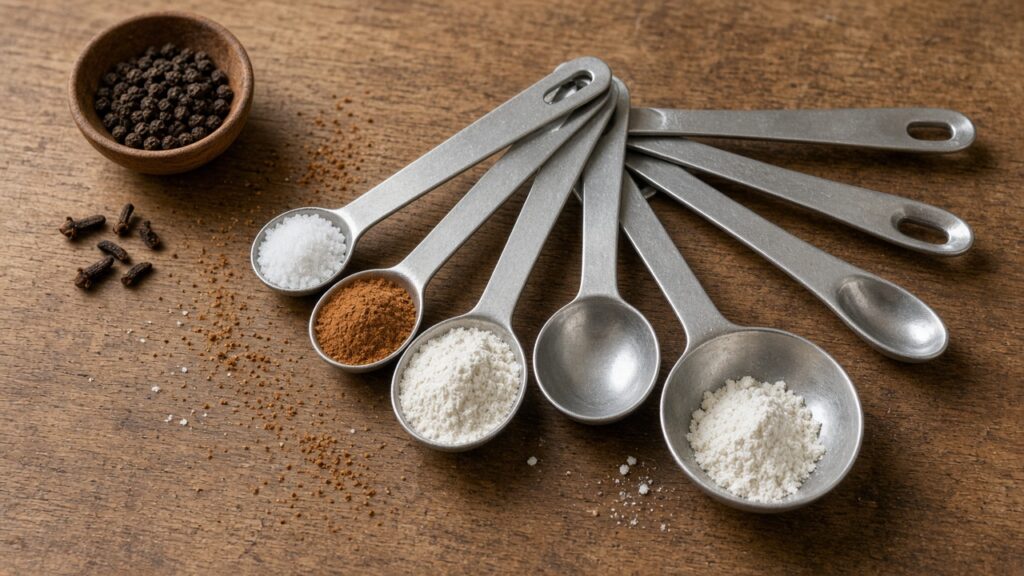
Magnetic measuring spoons have become a favorite in home kitchens for a simple reason: they solve two everyday annoyances at once. Their slim, often double-ended design fits into narrow spice jars, and the magnets keep the set together instead of scattered across a drawer.
If you bake often or follow recipes that call for amounts like 1/8 teaspoon or 3/8 teaspoon, the right set of measuring spoons can make a noticeable difference in accuracy and convenience. This guide explains how magnetic spoons work, which sizes are worth having, how to measure odd amounts when your set does not include them, and how to choose a set that will last.
What Are Magnetic Measuring Spoons?
Magnetic measuring spoons are sets of spoons with magnets built into the handles. The spoons snap together into a neat stack and often stick to the side of a refrigerator or metal backsplash. Many sets are double-ended, with a round bowl on one end for liquids and a narrow oval bowl on the other end that fits into spice jars.
Common features include:
- Magnets in the handle to keep the set together.
- Dual-sided design with a round end and a narrow end.
- A leveler for scraping off excess dry ingredients.
- Stainless steel bowls with plastic or silicone-coated handles.
Pros and Cons of Magnetic Measuring Spoons
Pros:
- Keep the set organized and easy to find.
- Narrow ends fit into small spice jars.
- Two sides per spoon mean you can measure wet and dry ingredients without washing in between.
- Many sets include a leveler.
Cons:
- Handles with embedded magnets are often not fully dishwasher safe, or recommended for top rack only. Check the manufacturer's instructions.
- Some sets only include the standard sizes and leave out 1/8 teaspoon.
- Magnets can attract metal crumbs or stick to other metal tools.
A popular style is the dual-sided magnetic measuring spoon set. Check price on Amazon.
Measuring Spoon Sizes You Actually Need
Most standard sets include four or five spoons. For serious baking, a few extra sizes help.
| Spoon size | Typical use |
|---|---|
| 1 tablespoon | Oils, sugar, flour, baking mixes |
| 1/2 tablespoon (1 1/2 teaspoons) | Some sets include it; useful shortcut |
| 1 teaspoon | Vanilla, baking soda, spices |
| 1/2 teaspoon | Salt, baking powder, spices |
| 1/4 teaspoon | Spices, extracts |
| 1/8 teaspoon | Strong spices, cayenne, salt in small batches |
Odd-size sets also include spoons like 2/3 teaspoon, 3/4 teaspoon or 1/16 teaspoon, which are handy for scaling recipes up or down.
Measuring Spoons With 1/8 Teaspoon
Many basic sets stop at 1/4 teaspoon. If your recipes call for 1/8 teaspoon often, buy a set that includes it. Look for spoons that are clearly engraved or stamped with the size, since printed labels can wear off.
Sets with 1/8 teaspoon are especially useful for:
- Cayenne, cloves and other strong spices
- Small-batch baking
- Salt in delicate desserts
- Adjusting recipes for one or two servings
You can browse options in a search for measuring spoons with 1/8 teaspoon. Check price on Amazon.
"Tad, Dash, Pinch and Smidgen" Spoons
Some specialty sets include novelty-labeled spoons for very small amounts. These names are not legally standardized, but they are commonly sold with these approximate values:
- Tad: 1/4 teaspoon
- Dash: 1/8 teaspoon
- Pinch: 1/16 teaspoon
- Smidgen: 1/32 teaspoon
Because these labels can vary from brand to brand, check the actual measurement printed on each spoon. A set like mini measuring spoons for dash, pinch and smidgen is useful for very small amounts. Check price on Amazon.
How to Measure Odd Amounts Without the Right Spoon
Even with a good set, some recipes call for amounts that do not match a spoon. Here are easy workarounds:
- 3/8 teaspoon: Combine 1/4 teaspoon and 1/8 teaspoon. See our full guide on how to measure 3/8 teaspoon.
- 1/8 teaspoon: Fill a 1/4 teaspoon and level it, then use a knife to push out half. Our guide on how to measure out 1/8 of a teaspoon shows the steps.
- 1/16 teaspoon: Measure 1/8 teaspoon and remove half, or use a "pinch" spoon. Read more in how do you measure 1/16 of a teaspoon.
- Liquids in tiny amounts: For extracts and flavorings, drops can be a practical guide. Our guide on how many drops to a teaspoon explains why the answer varies with the dropper and liquid.
- 1/3 tablespoon: Equal to 1 teaspoon.
- 2/3 tablespoon: Equal to 2 teaspoons.
How to Measure Accurately With Measuring Spoons
Dry Ingredients
- Stir or fluff the ingredient, especially flour and baking powder, to break up clumps.
- Dip or spoon the ingredient into the spoon until it is overflowing.
- Level it off with a straight edge, such as the back of a knife or the leveler that comes with many magnetic sets.
- Do not pack the ingredient unless the recipe says to, for example "packed brown sugar."
Liquid Ingredients
- Hold the spoon level over a separate bowl, not over your mixing bowl, in case of spills.
- Pour the liquid until it reaches the rim.
- Use the round end of a double-sided spoon, which is usually better for liquids.
Sticky Ingredients
For honey, molasses or syrup, lightly coat the spoon with oil or cooking spray first so the ingredient slides out cleanly.
Measuring Spoons vs. a Kitchen Scale
For flour, sugar and other larger quantities, a digital kitchen scale is more accurate than volume measuring because it is not affected by how tightly an ingredient is packed. For very small amounts, though, most home scales are not precise enough. A typical kitchen scale reads in 1-gram increments, and 1/8 teaspoon of baking soda or table salt typically weighs less than a gram. That is why even cooks who bake by weight keep a good set of measuring spoons for leaveners, salt, spices and extracts.
How to Choose the Best Measuring Spoons
- Material: Stainless steel bowls are durable and will not absorb odors. Avoid thin metal that bends easily.
- Engraved markings: Stamped or engraved sizes last longer than printed ones.
- Shape: Narrow or oval bowls fit spice jars; round bowls are easier to level and clean.
- Range of sizes: Look for 1/8 teaspoon if you bake often, and odd sizes like 3/4 teaspoon if you scale recipes.
- Storage: Magnetic sets, ring-held sets or sets with a storage case all work; choose what fits your drawer or wall.
- Cleaning: Check whether the set is dishwasher safe. Magnetic handles often recommend hand washing.
How to Care for Magnetic Measuring Spoons
Hand wash with warm, soapy water and dry right away, especially where the magnet is embedded in the handle. Store the spoons together on the magnet or in a drawer away from sharp utensils. If a set's markings begin to fade, consider replacing it, since guessing at spoon sizes defeats the point of measuring.
Frequently Asked Questions
Are magnetic measuring spoons accurate?
Quality sets are generally as accurate as other measuring spoons. Accuracy depends more on how carefully you fill and level than on the magnetic design.
Are magnetic measuring spoons dishwasher safe?
Some are, but many recommend hand washing or top rack only to protect the magnets and handle materials. Always check the manufacturer's care instructions.
What is the difference between a dash and a pinch?
In spoon sets that include them, a dash is usually 1/8 teaspoon and a pinch is usually 1/16 teaspoon. Traditionally, a pinch is the amount you can hold between your thumb and forefinger.
Do I need a 1/8 teaspoon measuring spoon?
If you bake frequently or work with strong spices, it is very useful. Otherwise, half of a level 1/4 teaspoon works in a pinch.
Can I use the same spoon for wet and dry ingredients?
Yes, but measure dry ingredients first, or use the other end of a double-sided spoon, to avoid clumping.
Final Thoughts
Magnetic measuring spoons are a small upgrade that make everyday cooking and baking easier. Choose a sturdy stainless steel set with engraved markings, make sure it includes 1/8 teaspoon if you bake often, and keep a few simple tricks in mind for odd amounts. With the right spoons and careful leveling, your recipes will turn out more consistently.